Oplema launch day
Today, 8 November 2026, Jens and I launched Oplema. You can create an account, get free credits, and start using the product. We wanted to see what worked once it was out of our own setup and real people could use it.
The launch date had already moved once. We originally planned for 1 November, then pushed it to 16 November. It was the first deadline I’d ever missed, and I wasn’t happy about it. It wasn’t because we’d been slacking: I’d been working 8–10 hour days for months, then probably 12–14 hours a day through October. We still needed more time. In the end, we decided to release today and use the next few days to look for bugs in production. A product can seem fine in our own testing and still behave differently once other people get their hands on it.
The project started on 27 May, when I pitched the idea to Jens. For the first couple of months, we called it Crimson Mesa. Whenever we said the name to someone, they’d tell us it was too long. Jens suggested Oplema, the name of a company he’d had before that sent SMS messages to dental clinics. There was something cool about bringing back a name he’d already used. Oplema doesn’t mean anything. We could invent a backronym for it now, but that would be larping. We just thought it sounded cool.
We scraped lists of five- and six-letter .com domains. Oplema came out on top: easy to spell, and it passed the radio test. To me, .com is king. We registered the other endings defensively, so nobody could copycat us there like they did with ScanToExcel. They all redirect to the .com: .ai, .co, .co.uk, .info, .io, .net, .org, .shop, .store, .uk, .us and .xyz. On 2 July, we incorporated Oplema ApS.
Part of that decision came from what happened with ScanToExcel. I found one-to-one copies of the site on scantoexcel.co and scantoexcel.ai. Maybe Oplema is different because it’s a distinct name we came up with rather than a descriptive one like ScanToExcel. Still, after seeing my own site copied onto other domains, I didn’t want to take the chance again.
Five months isn’t a long time to build a company, but this is the biggest project I’ve ever taken on. There’s the product, the company, all the decisions that come with both, and the constant feeling that there’s more to do than two people can get through. Almost everything I’ve done since May has somehow connected back to Oplema.
The product is already more than a demo. Create an account and you get free credits to use AI compute, build workflows, and host dashboards. There are 19 connectors across cloud files, business apps and databases, including Google Drive and Sheets, OneDrive, Dropbox, Airtable, Notion, HubSpot, Stripe, QuickBooks, Xero, Postgres, MySQL, MariaDB, Microsoft SQL Server, Supabase, Snowflake, BigQuery and Databricks. You can also bring in local Excel, CSV, JSON and Parquet files, or use Oplema’s own cloud storage.
You can schedule workflows and host dashboards. We tried a scheduled flow that read a file from Google Drive and wrote the result to OneDrive. That worked. Hosting worked too. I expected those parts to be shakier on day one, and the connector checks were one of the first things we did after launch. Most worked. We had some problems with the database connectors, particularly SQL Server, Postgres and MySQL, but we’ve since fixed those.
At launch, each account gets 800 MB of file storage and 200 MB of project storage. Data transfers over 50 MB are paid. You can’t buy more storage yet. More storage options and database storage are for the future; right now, storage is just files and projects. The paid-feature checkout is the embarrassing part: we thought Paddle was ready, and it isn’t. We’re working on it now. Fingers crossed they don’t decline us xDDD.
We launched with Elara, our AI harness, and it works really fucking well. Jens cooked with that harness. It includes our own models, Elara Spark and Elara Flame, alongside a long list of models from OpenAI, Anthropic, DeepSeek, GLM, xAI, Mistral, Google and MiniMax. The exact menu depends on region. Right now we serve the US East and West, the EU, and Asia through Singapore. The first setup uses Cloudflare, Fly.io and Hetzner, with OpenRouter and Eden AI for model access. Umami and Google Analytics 4 handle analytics. It’s a very early stack, and some of it will change. That’s part of the snapshot too.
There is plenty that still feels rough, and plenty we haven’t built yet. Strata and Vista need a lot more building blocks and capabilities: geospatial work, machine learning, computer vision, and JSON-based product automation in the style of n8n or Zapier. The interface and details need work too. Some collaboration bugs can lock you out when people branch the same project. The marketing pages on mobile are rough; the app itself isn’t meant to be used on a phone. We also need a real ticket system. So far we’ve been stitching together Messenger, Trello, Discord and whatever else was nearby. That is not a system.
The hardest decision was stopping feature work. We froze features about a month ago and tried to get the existing ones to work properly. We thought the ETL workflow would be the difficult part. It turns out that a dashboard can be just as hard, especially filters and parameters. They depend on the underlying flow, and our data work and dashboard live together as one project. Then the AI features and version control have to understand that same project too. Every piece touches another one.
Jens also changed how I thought about version history. I first imagined Echo, which we originally called Trail, as a kind of log: a place to see whether a person or the AI had run a workflow. Jens pushed it toward Git for operators. That was much smarter. Branches make sense for data workflows, though merging isn’t there yet, and we still have to work out the rough edges. I don’t know exactly what it will become. The door is open.
I think visual canvases will stick around. People are still reluctant to hand all the control to AI, and a canvas gives them a way to see what is happening and change it. I also think version control in a data tool matters. Both ideas might look ridiculous in five years. They might also be the parts that make Oplema work. This is one of the things I want to save in writing, before I know which it is.
For November, December and January, the plan is to slow down, fix things and refine the product. We’ll post about Oplema on LinkedIn next week, but we aren’t going to push it hard while it’s still buggy. Hopefully some organic traffic finds us, and we learn from the people who try it. Then we’ll see what deserves the next big push.
When I say I want Oplema to become a billion-dollar company with ten people, I mean ten people who carry an absurd amount of weight. Engineers, mathematicians, physicists, chemists: people who think for themselves, work hard, and bring ideas instead of waiting to be told what to do. If the arithmetic is $100 million of value per person, then we have to build the company around people who can do that. HR, finance and the rest of the corporate machinery can be outsourced. I don’t want to build a miniature version of a large company. I want a small team that can do things a small team shouldn’t be able to do.
If Oplema works, I want to take it public in Denmark, and probably earlier than would make the most sense financially. Everyone says Denmark needs technology companies. I want to build one, then be honest about what made it hard and what needs to change. Complaining about the lack of companies is easy. I’d rather help make one exist.
That’s the launch-day claim: we can build a billion-dollar company with ten people. I think it will happen. Right now, the checkout is broken, the interface needs work, there are bugs to fix, and we’re still figuring out the ticket system. But the workflows run, the schedules work, the dashboards host, and the product is out there. Let’s fucking do this.
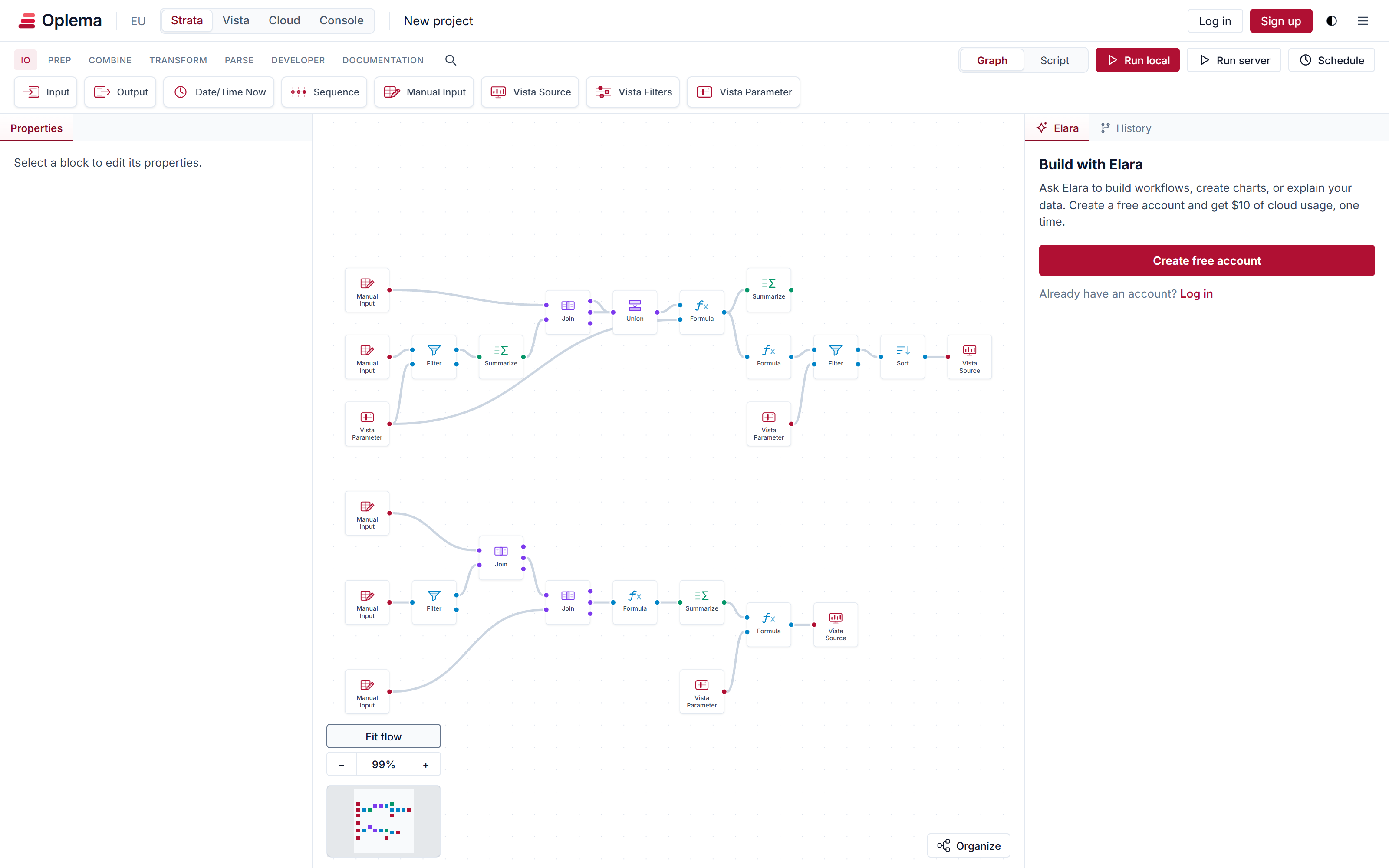
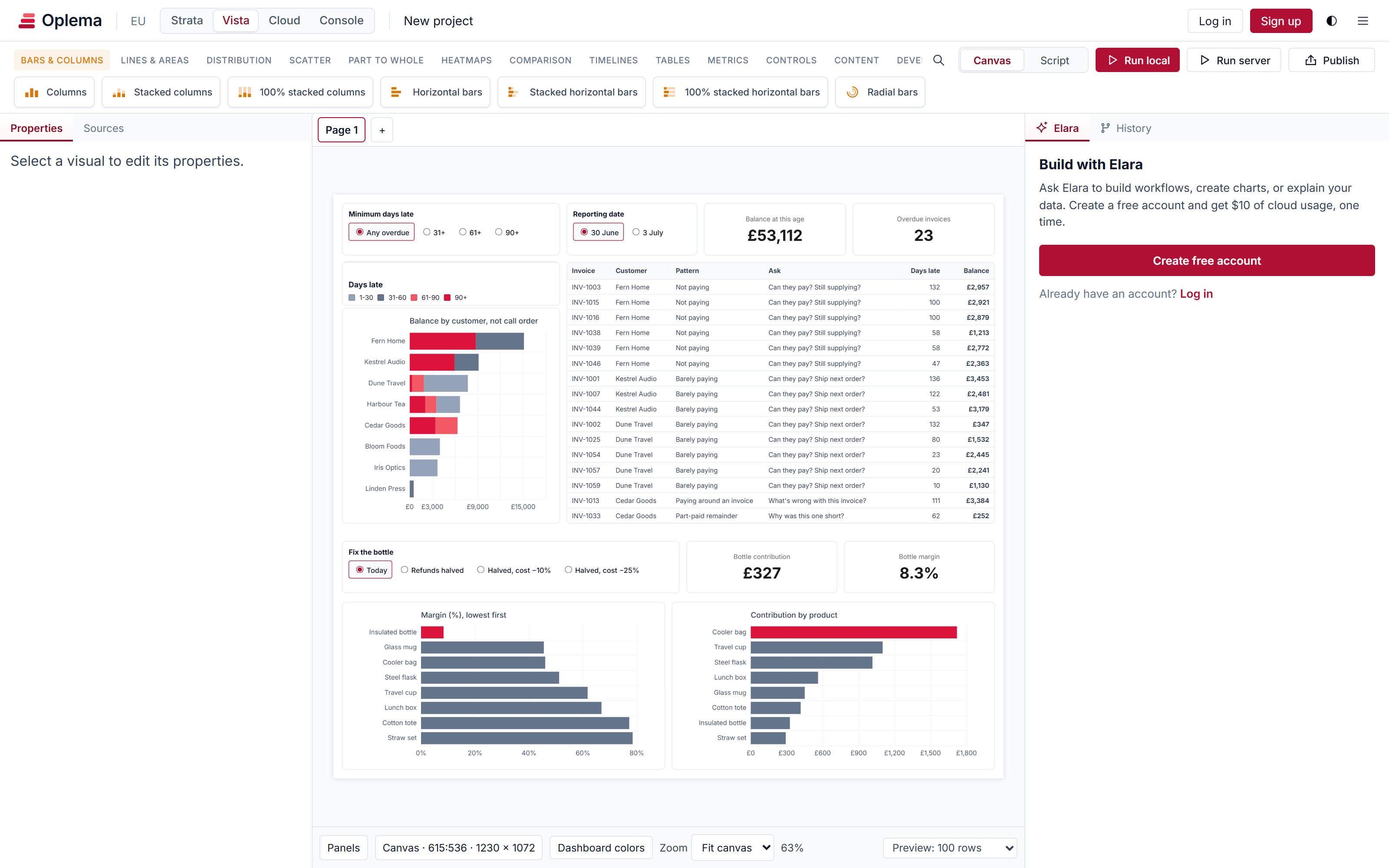
Launch day in screenshots
The site and product will keep changing, and in a year the things that feel obvious today will probably be hard to remember. This is what Oplema looked like on launch day.
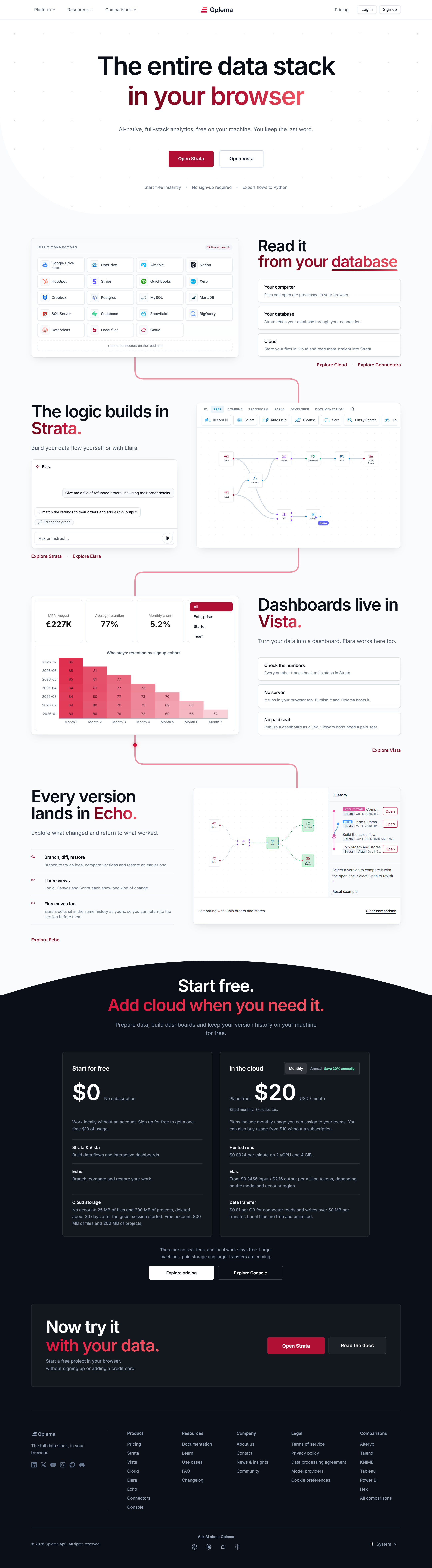
These are random sample workflows and data, but they capture the interface, colors and controls as they looked on day one.