The great equalizer
The day after the Democrats’ midterm wins, the market rallied. I saw Democrats taking a victory lap, as if the rally proved Wall Street liked the results. Then, the day after that, the rally was gone. AI-linked stocks led a sharp sell-off. By the end of Thursday, roughly $3 trillion in market value had been wiped out. The S&P 500 closed down 4.4%, more than erasing the previous day’s gains.
The AI trade had already been under pressure. Investors were questioning how much the infrastructure spending would earn back. The tech companies I follow hadn’t reported disappointing results. Their fundamentals were strong and the outlook was bright, but the stocks were cheap. It felt as if investors didn’t believe the forecasts. Then the Democrats won control of Congress, and the prospect of a slower AI build-out became part of the market’s calculation.
Bernie Sanders has been one of the loudest voices calling for a federal moratorium on AI data centres and a pause on advanced AI development. I find it frustrating to hear him speak with such certainty about an industry he doesn’t understand. The risks he points to are real. But a moratorium doesn’t address them; it restricts the infrastructure and competition that could help us deal with them. (Sanders on a data-centre moratorium; Sanders on pausing advanced AI)
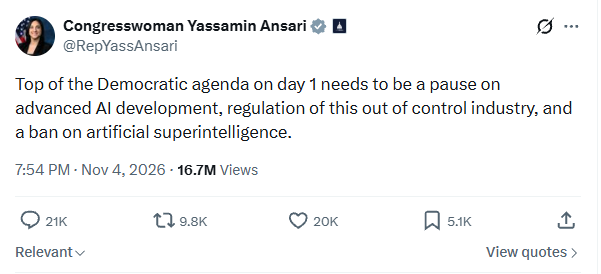
The day after the election, Congresswoman Yassamin Ansari was one of many Democrats calling for a pause on advanced AI development and tighter restrictions. Her post wasn’t the only thing behind the sell-off, but it was fuel: she was spelling out the agenda Democrats had campaigned on. The market may have rallied first. By Thursday, investors were taking that prospect seriously.
My portfolio wasn’t what stuck with me. It was what the sell-off might mean for building with AI. For Jens and me, AI has been a great equalizer.
Jens and I have spent the past five months building Oplema. We are two people on a small company’s budget, making a product I think would have taken 40 engineers two or three years to build a decade ago. It’s a rough comparison, but we can try more things and build more of the product ourselves than a team our size could have managed back then.
We cannot afford to hire 40 engineers. We can afford our AI subscriptions. That’s the difference.
Software doesn’t build itself. Someone still has to understand the problem, make product decisions, connect the pieces and work out why something breaks. But AI lets a small team take on more of that work itself and attempt things that used to require a much larger one.
That’s why calls to stop building data centres bother me. AI won’t disappear if the US or Europe builds fewer of them. The existing models and facilities will keep running, and the companies with enough money will keep using them. There will just be less new capacity, less pressure to bring prices down and less room for new competitors.
Compute is expensive. Training models and serving millions of requests takes chips, power, buildings and networks. If demand keeps growing while governments limit new capacity, there will be less of it. That’s basic economics: less room for new competitors and higher costs for everyone trying to get access. It makes little sense to promise that AI should benefit everyone while making it harder to build the infrastructure that could put downward pressure on prices.
We already have independent labs, open-weight models, smaller cloud providers and companies like ours building with the tools available. When compute gets scarce, the biggest companies can reserve it, pay more and keep experimenting. A small lab, a startup or an individual developer has fewer options. Rules with high fixed costs can tilt things the same way: they may apply to everyone, but the biggest companies are the ones best placed to comply.
To me, that’s regulatory capture. And the stakes go beyond a few corporations owning more compute. If AI stays scarce, corporate and political elites will have more say over which systems get built, what information they can draw on, how they answer and who gets access. That’s power over what people can know, as well as over who gets to compete. Maybe that isn’t what Sanders or Ansari intend, but that is what will happen: ordinary people will depend more on institutions that already shape what gets built and what information reaches the public. And we know how that has worked out in the past, right?
I can’t stop thinking about attempts to control information. The Soviet state controlled publishing and distribution. The Nazis burned books in public. A pause on AI isn’t the same as either of those things. But it skirts a line that makes me uneasy: the state limiting a tool that gives ordinary people direct access to information and capability. The people calling for a pause may see it as a safety measure (or at least that’s how they frame it). I see the old temptation to decide what other people should be allowed to read and use. (Library of Congress on Soviet control of publishing and distribution; U.S. Holocaust Memorial Museum on Nazi book burnings)
AI can be wrong. People still need to think for themselves. But it also gives you a way to check what you’re told, ask questions and learn without waiting for an institution to open the door. If the US makes it harder to build, I’ll learn Chinese (hopefully not) and read the docs for the models advancing elsewhere. We’re not going to stop using AI because our politicians decide not to build.
I don’t think we should stop building because of concerns about power, water or safety. The claim that every data centre simply takes electricity away from homes is too simple. Developers are increasingly bringing power on-site or arranging it behind the meter, though many still rely on the grid. They also bring tax revenue that helps pay for local services and infrastructure; in communities that negotiate a good deal, it can more than offset the added costs. Cooling can use very little water with the right design, but it depends on the site. I think today’s models are safe enough to use; they can still be wrong, and sensible safeguards matter. These are things to work through, not reasons to stop building. (Congressional Research Service on data-centre power options; Lawrence Berkeley National Laboratory on data-centre water use; Washington State legislative auditor on local tax-base effects)
This is a question of whether politicians understand AI. I don’t think many of them do. The recent discussion between Martin Thorborg, a Danish business owner, and Zenia Stampe, a left-wing politician, on DR’s Debatten made that obvious to me. As a Dane, it felt particularly close to home. They got stuck arguing about who deserves credit for a book written with AI, as if that settled the question. I don’t know exactly how the market will develop, how much compute we’ll need or which jobs will change first. But I know what these tools have let our two-person team try to build. So when politicians talk as if restrictions will only affect a few large companies, I don’t think they understand who else depends on this technology. (DR’s Debatten: “Kunstig intelligens, kunstig kultur?”)
The people who stand to lose the most from less access are the ones who can’t afford a team. A small business owner, an independent developer or someone trying to start a company can use AI to do work that used to mean hiring specialists. Companies like ours are also trying to build the software platforms Europe keeps saying it needs. If politicians restrict the infrastructure we depend on, they make that harder. It doesn’t make us equal, but it does make the gap smaller.
The negative tone around AI and data centres didn’t start with this election. For years, I’ve heard Europe say it needs more technology companies, more AI and more sovereignty. We are nowhere near there yet. Now the US is hearing calls for pauses, bans and restrictions, too. To be honest, they should take a look at the EU to see how well we’re doing (that’s a joke, by the way). An election result isn’t a law, and a lawmaker’s post isn’t a policy. But turning those calls into policy would make it harder for companies like ours to build the very technology both sides say they want.
I understand some of the anger in the US, too. AI leaders talk about UBI and a future where nobody has to work, while warning that AI could wipe out humanity. Meanwhile, the biggest labs remain private, with valuations around $1.5 trillion, maybe closer to $2 trillion by now. The public gets to use the tools and hear the extinction warnings, but has no direct stake in the labs’ financial upside. I can see why people are pissed and, frankly, scared. Sam Altman and Dario Amodei need to stop fear-mongering. When they push for regulation while their companies stand to benefit from barriers to entry, regulatory capture looks like the obvious endgame.
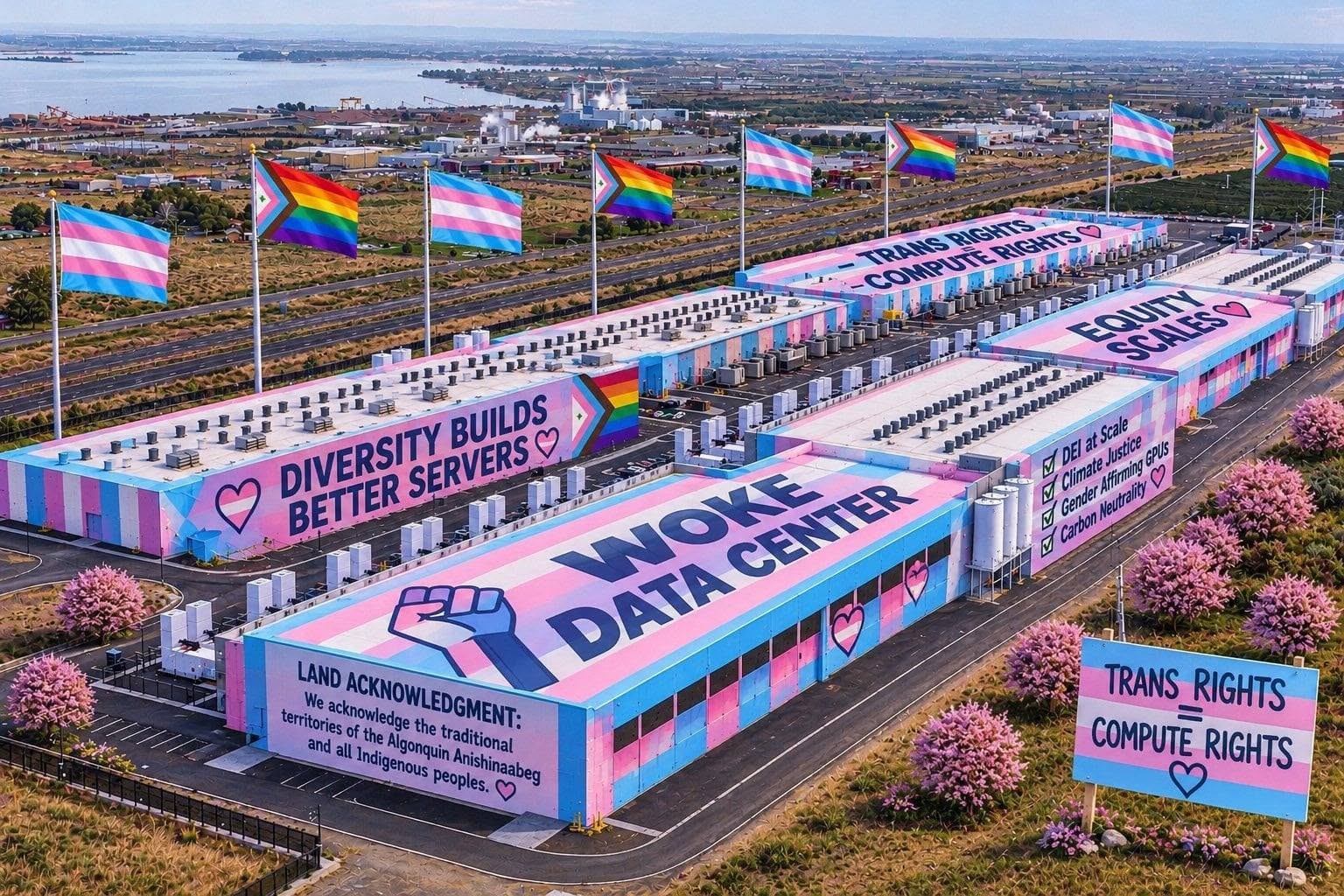
Still, not every politician wants data centres gone. Meta president Dina Powell McCormick said an unnamed governor-elect who campaigned on data centres had already asked to meet after inauguration: “We don’t want to lose this investment in our town. We don’t want these jobs to go elsewhere.” She didn’t name the governor. A MAGA data centre and an LGBTQ data centre still produce the same tokens. (WSJ interview with Dina Powell McCormick)
Everyone complains that Europe doesn’t have enough technology companies. I want to do something about it: take Oplema public on Nasdaq Copenhagen at a $1 billion valuation and give the public a chance to share in the upside. It may not be the smartest move financially. After that, I’d love to see if Jens and I can build it into a $10 billion company with ten people.
AI is what makes me think a small Danish team can even attempt that. We cannot afford 40 engineers, but we can afford our AI subscriptions. Restricting the infrastructure won’t stop AI; it will make access more expensive and leave more control with the people who already have it. I want more people to have the chance Jens and I have had.
The good always wins. Innovation always wins. We will win.